Acutely aware that I haven’t written a blog post for some time, I was wrestling to find a suitable topic. It has certainly been an eventful few months, with many ups and downs. Having completed my PhD – and leaving aside the difficulties of the post-doctoral job market – I have been lucky enough to become one of the new Fellows In Applied History based (virtually) at the Institute of Historical Research, working primarily with the team curating The Social History Archive. In July I had my PhD graduation, then presented at two fantastic conferences, visiting Trinity College Dublin for the first time as well as going back to Liverpool John Moores University. I was particularly thrilled that my thesis was awarded the Sally Mitchell Dissertation Prize by the Research Society for Victorian Periodicals as reported on social media at the time. It was thinking about this that led me to the subject of this piece.
Research is both directly and indirectly collaborative, of course. We all stand, as Newton put it, on the shoulders of giants. One of the undoubted giants of the scholarship of the nineteenth century periodical press is Professor John North, late of the University of Waterloo, Ontario, Canada, who passed away on 10 August 2026 at the age of 86. The university’s memorial page can be found here.
Now, I never met John North. We did correspond briefly, after the ever-generous Patrick Leary put us in contact. This was so that I could gain access to what is perhaps Professor North’s greatest legacy – The Waterloo Directory.
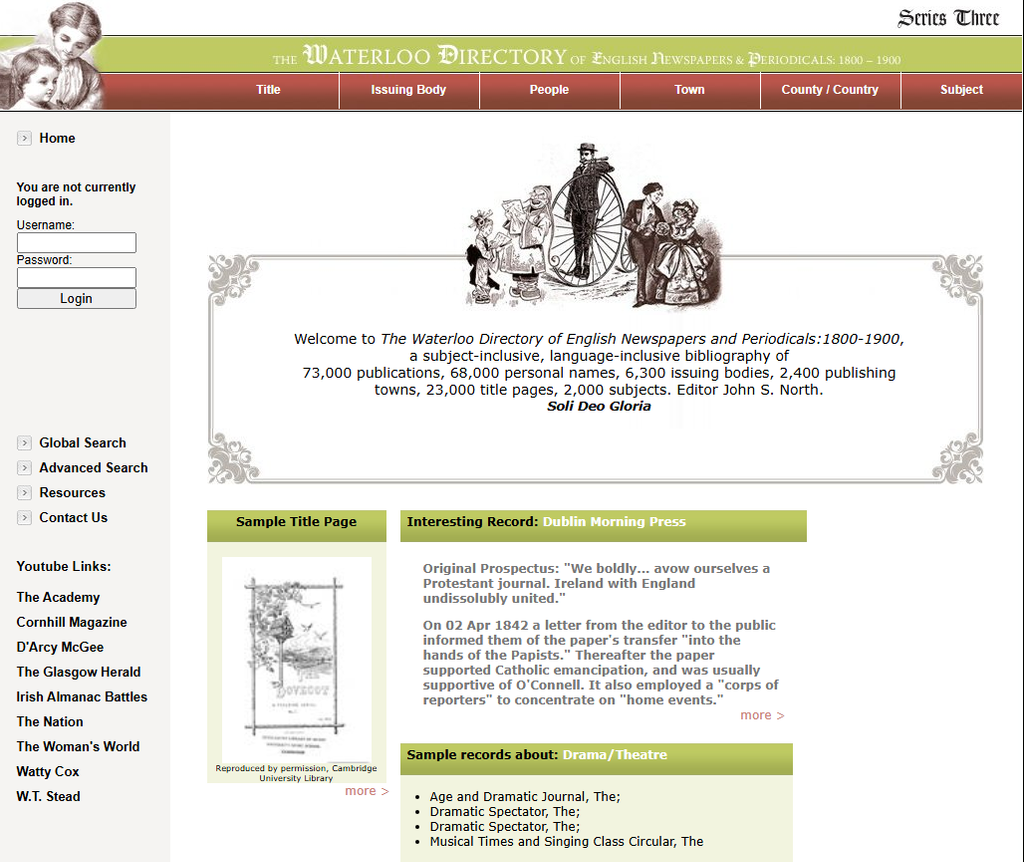
The screenshot of the public homepage gives just a small hint of the riches contained with this database, with details of over 70,000 publications over the nineteenth century. In some cases, the evidence in the database is all that remains. The initial versions of the Directory were printed (you can still find them on the shelves in the British Library’s Newsroom) and later converted to this electronic form. This rich resource is a go-to asset for scholars wanting to find out about specific nineteenth-century newspapers and periodicals, containing publication histories, title changes, details of proprietors, editors and contributors, together with some key works of scholarship. It isn’t perfect, of course – the sheer scale of information, collected over decades with many contributors, means that there are occasional replications. It could not possibly keep up with every new perspective in the field, but was always a work in progress. Still, it is a monumental achievement. Laurel Brake accurately praises it as ‘our most inclusive digitized reference work on the nineteenth-century press’.[1]
In the early stages of my PhD research into short-lived nineteenth-century newspapers, I spent some time seeking to answer the question ‘was longevity the norm or the exception’ in respect of nineteenth-century newspapers. To do so, I had to find a way to conduct statistical analyses of the various catalogues and databases that detail what we know of the press of that time. I began, of course, with the British Library’s catalogues of its holdings but gaining access to the Waterloo Directory was priceless. It was largely as a result of being able to interrogate and compare statistical findings from these two independent large-scale sources that I was able to demonstrate the prevalence of short-lived newspapers in the nineteenth century. This became the opening argument for my PhD thesis. The Directory also provided a key selection of the data from which I drew my essay ‘The Long and Short of it: rethinking the longevity of nineteenth-century periodicals’ which won the 2023 Rosemary VanArsdel Prize and, when published in late 2024, was transformational in bringing my research to the attention of colleagues in the scholarly field.
Professor North was, justifiably, protective of the Directory. He achieved a great deal in his distinguished career, as the tribute from the University of Waterloo makes clear. Surely, though, there is no greater legacy than the Directory which bears not his name but the name of the institution where he spent his entire career. I earnestly hope that arrangements have been made to ensure that the Directory continues to evolve and be made available to scholars. My work has benefited enormously from that legacy and will, I hope, continue to do so in future. I will never have the opportunity to thank John North directly but I offer this small tribute to a true giant of nineteenth century periodicals research.
You’ll see that, on the Waterloo Directory’s homepage, he quotes Soli Deo Gloria (Glory to God alone). I respectfully disagree.
[1] Laurel Brake, ‘Nineteenth-Century Newspaper Press Directories: The National Gallery of the British Press’, Victorian Periodicals Review 48:4 (2015, pp. 569-590), p.575
What a wonderful tribute to a great man he may not physically be here but he leaves such a treasure trove of a legacy filled with jewels of knowledge that researchers who search will find and be all the richer for it.