This is a ‘before and after’ comparison of two of my three original (1858-60) volumes of the Illustrated News of the World.
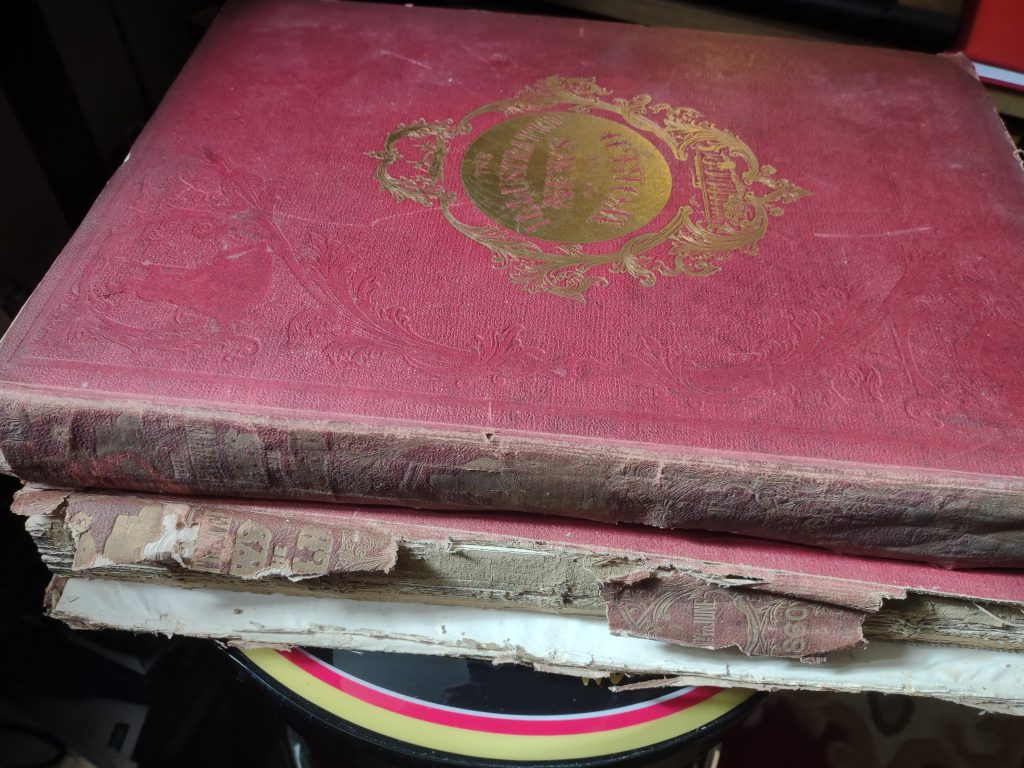
You’ll see that, for the most damaged volume, it was necessary to have an entirely new spine made.
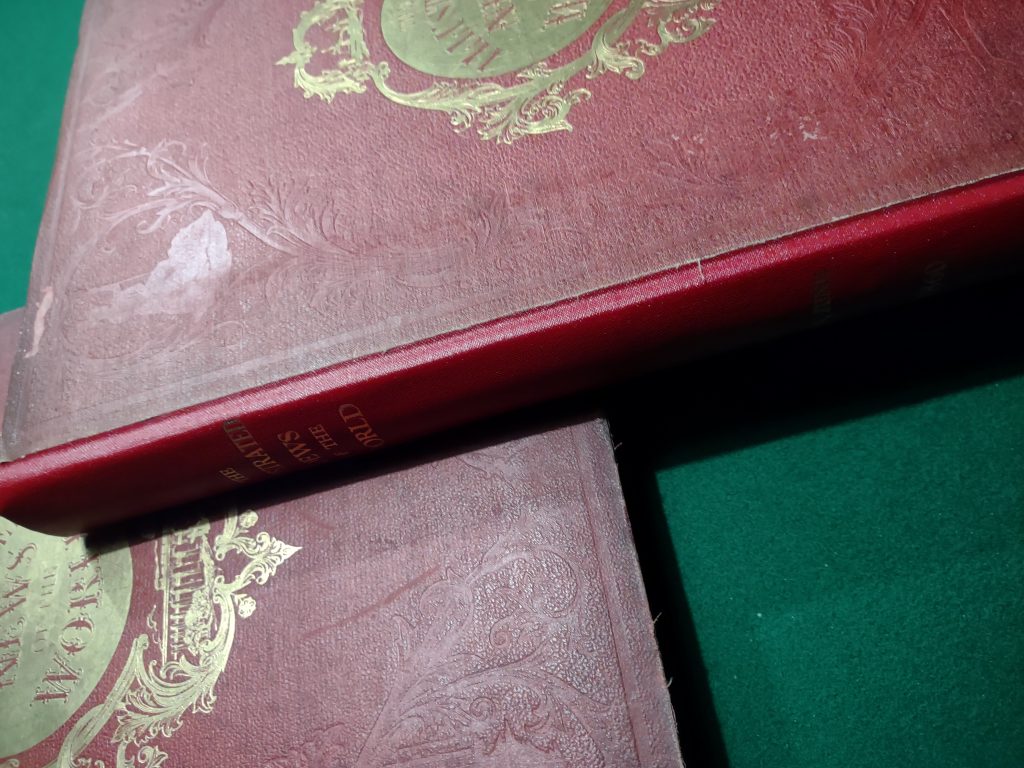
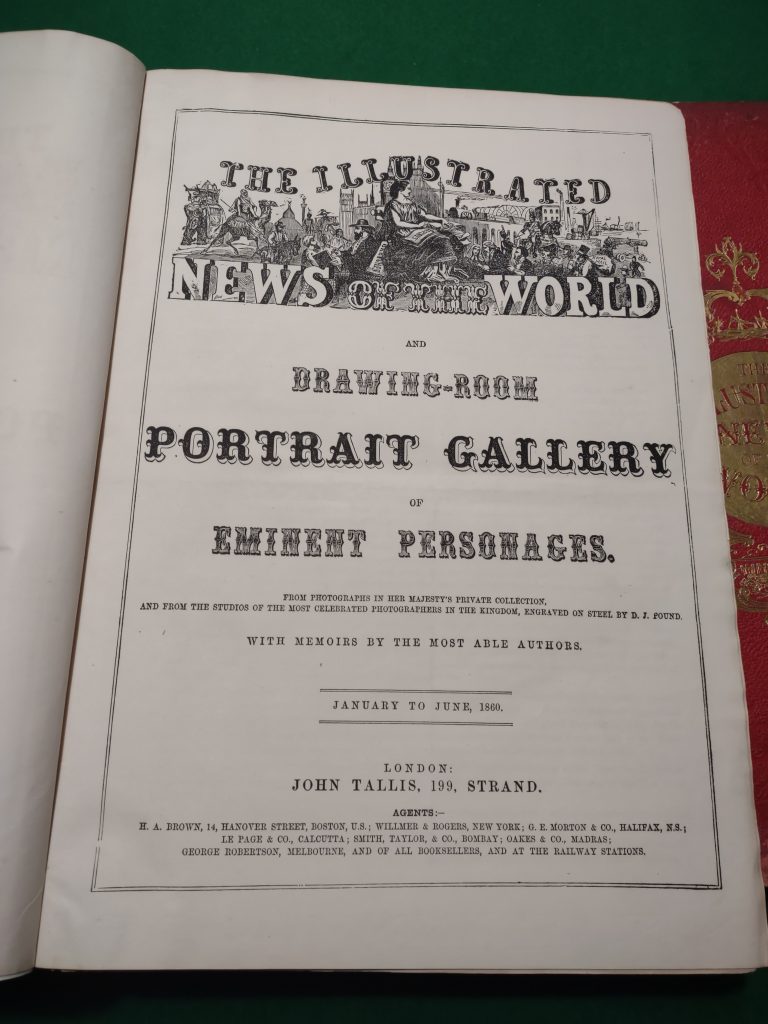
What this has demonstrated to me is the importance of traditional artisan skills. The fabulous bookbinder (details available on request) has carried out a wonderfully sympathetic restoration, retaining as much as possible of the original binding boards and spines. For two of the volumes, the repairs are all but invisible. Most importantly, they are now in a state where I can enjoy opening them up to view the contents. As you can see in the next picture, this was a newspaper that deserves such treatment – an ultimately doomed but splendidly audacious, very high quality competitor to Herbert Ingram’s Illustrated London News.
Despite the convenience of digitised versions of historical newspapers – and, let me speak plainly, my PhD would have been impossible without them, so I am very much in favour of them – there’s still something magical about handling the real thing, however fragile the physical artefacts might be. So, having been gifted these volumes of one of my favourite Victorian periodicals, I wanted to try to preserve them.
Finding a working bookbinder wasn’t easy, to my surprise. When I worked in universities (admittedly a few years ago now) every PhD thesis – and not a few Master’s dissertations – were required to be submitted as a hardbound book as the final stage in the process. Every university library has shelves full of them – many sadly forgotten but representative of thought, effort and application. I was looking forward to this sense of validation of my work over the last four years but…that’s so last century, apparently. All that’s required these days is a digital upload. Very convenient, much cheaper for the student and requires no physical library storage space. Am I, though, alone in thinking that something of the sense of achievement is lost? I also feel for the bookbinders who once had a steady business from postgraduate students and whose services are no longer needed. Once these skills are lost, it will endanger historical objects like these newspaper volumes and all we’ll be left with is the digital remediations – at least until that form also becomes obsolete, probably much sooner than have the print archives.
Well, it may not be be required for the university library, but I’m going to get a bound copy of my thesis anyway. It might be outdated but, speaking as a newly-minted historian (of the print media, no less!), it feels appropriate to have one for posterity.
What an amazing piece of work from the bookbinder – absolutely wonderful. Your words bring to life the significance of preserving historical artefacts and is something that we should all try and take ownership of. So much history is lost in the name of modern progress and these are losses can not be regained. I really enjoy you work, it is so engaging I have now developed a genuine interest in historical newspapers. I look forward to reading your book (hopefully you are engaged in writing one) and await your next piece of research with interest. Will you post a photograph of your bound copy of your thesis please? And please forward me details of the bookbinder.
Thank you Jessica – that was very kind of you. I’ll email you the bookbinder’s details directly.
I enjoy hearing about your work and have heard via word of mouth that your lecture in Shropshire was very well received but alas there were no seats left when I arrived. Could I ask if you have any new projects in the pipeline and will you be putting posts up about this? I am certain with such wonderful bound copies of the ‘The Illustrated News of the World’ you will be busy working on another project Could you also post when you are giving another lecture and where this will be please?
I look forward to hearing more about the historical press and its impact on society
Thank you. I’m sorry you missed the lecture I gave to the Church Stretton History Group – this was all the more rewarding as it was in the town where I attended secondary school. But it was on the subject of the ‘Iron Maidens’ – the Quaker women of the Ironbridge Gorge in the 18th and 19th centuries.
For now, I have a few other irons in the fire, so to speak. In particular, I have recently been given the opportunity to undertake a new role as Co-Editor (with Dr David Mislin of Temple University, Pennsylvania) of Volume 2 of a forthcoming three-volume series for Edinburgh University Press, on the Radical Press of the long nineteenth century. My first editing role and very exciting. Watch this space for further updates!
Conratulations I look forward to hearing about this and your other projects.